













What Holistic Development in a Preschool Actually Means
Every Indian preschool promises holistic development. Here is what the term really means in practice, and how parents can test the claim on a school visit.

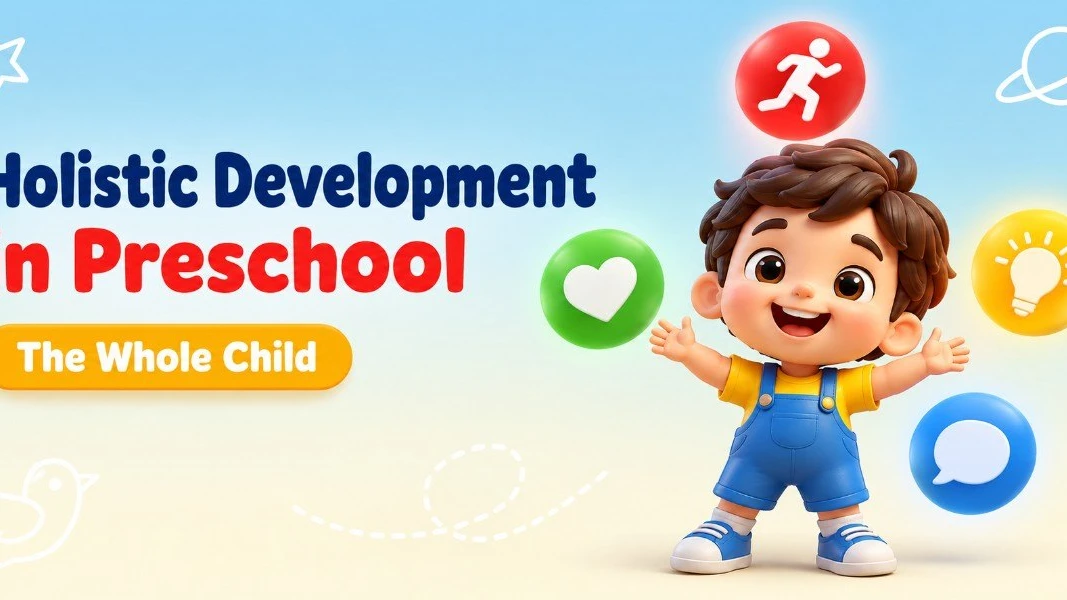

Holistic development in a preschool means the school builds the whole child, physical, thinking, language, emotional and creative, rather than pushing early academics alone. Nearly every preschool brochure in India uses the phrase, so it has stopped telling parents anything useful. The way to judge it is to stop reading the brochure and start watching the classroom. This guide breaks the term into plain parts and gives you specific things to look for on a visit.
What does holistic development actually mean in a preschool?
It means the daily programme deliberately builds several areas of a child at once, body, mind, language, feelings and imagination, instead of focusing only on reading and writing.
A young child does not learn in subjects. When a four year old builds a tower with blocks, she is judging balance, counting, naming shapes, negotiating with the child next to her and managing frustration when it falls. One activity touches four or five areas of development at once.
Holistic development means the school understands this and plans for it, so that no area is left out over the course of a week. It is a planning discipline, not a philosophy that needs a special name or a special fee. This explainer on how preschool builds confidence, creativity and curiosity covers the same ground from a different angle.
The phrase becomes marketing when a school claims it but runs a timetable of copywriting and worksheets. The label is then on the brochure and not in the room.
Which areas of development should a good preschool cover?
Five areas are widely used in early childhood settings, physical and motor, cognitive, language and communication, social and emotional, and creative and aesthetic development.
Physical and motor development covers large movements such as running, climbing and balancing, and small hand movements such as holding a crayon or threading beads. Cognitive development covers thinking, sorting, sequencing, early number sense and problem solving.
Language and communication covers listening, vocabulary, expressing needs and early story sense, often in more than one language in Indian settings. Social and emotional development covers sharing, turn taking, naming feelings and recovering from small setbacks. Creative and aesthetic development covers art, music, movement and imaginative play, where there is no single correct answer.
|
Area of development |
What it covers |
What it looks like in a good preschool |
|
Physical and motor |
Large movement and small hand control |
Daily outdoor time and climbing, plus beads, dough, pouring and scissors indoors |
|
Cognitive |
Thinking, sorting, patterns, number sense |
Puzzles, sorting trays, building material, questions the child has to work out |
|
Language and communication |
Listening, vocabulary, self expression |
Story sessions, conversation circles, songs, picture talk, children encouraged to speak |
|
Social and emotional |
Sharing, turn taking, naming feelings |
Group games, classroom jobs, a teacher who helps children resolve disputes rather than only ending them |
|
Creative and aesthetic |
Art, music, movement, imagination |
Open ended art with no fixed model, dress up and pretend play, instruments and dance |
How is holistic learning different from early academics?
Early academics teaches formal reading, writing and arithmetic ahead of time, while holistic learning builds the underlying abilities that make those skills easier and more durable later.
Many Indian parents feel reassured when a three year old brings home a page of neatly formed letters. It looks like progress. The difficulty is that neat letters at that age usually reflect drilling rather than readiness, and drilling has a cost in attention span and in a child's appetite for learning.
Formal writing needs finger strength, wrist control, eye tracking and the ability to sit with a task, and those come from clay, sand, pegboards, climbing and cutting. A preschool that spends the year on those is not behind, it is building the base.
This does not mean letters and numbers are banned. A good preschool introduces them through sound games, names, songs, labels and counting in real situations. The difference is whether the alphabet is met in play or delivered as homework.
How can a parent test the claim during a visit?
Ask to see an ordinary working day, not a demonstration, then check each of the five areas with your own eyes and ears in about twenty minutes.
Look at the walls first. If every display is identical, twenty copies of the same craft cut to the same shape, the children were following an adult's model rather than making something. Displays that differ from each other, including messy ones, are a better sign.
Listen to who is talking. In a room that builds language, children talk to each other and to the teacher, and the teacher asks questions that need more than a yes or no. A room where the only voice is the teacher's is a room being managed rather than taught.
Also ask what the school does when a child is struggling. A holistic programme answers with observation and small adjustments. A weaker answer is extra worksheets or extra practice at home.
-
Physical, ask where children go outdoors, how often, and what happens on a rainy day
-
Cognitive, ask for one example of a problem the children solved themselves this week
-
Language, watch whether a shy child is drawn into conversation or left quiet
-
Social and emotional, ask how the staff handles biting, hitting or a child who will not share
-
Creative, ask to see the art shelf and check whether children can reach the material on their own
What does a holistic day look like in practice?
A balanced preschool day moves between quiet and active, indoor and outdoor, adult led and child led, usually in short blocks suited to a young attention span.
A typical shape starts with circle time, where children greet each other, share news and sing. That is followed by a focused activity in a small group, then free play at stations offering blocks, pretend play, books and puzzles. Outdoor movement comes before or after, depending on the hour and the weather.
The later part usually includes a story, an art or music block, a snack eaten together, which is itself social learning, and a rest period for the younger groups. What matters is that all of it appears on most days, not only on annual day.
Ask for the actual weekly timetable and count the blocks. If free play, outdoor time and art appear as short leftovers around a long academic core, the timetable is telling you the school's real priority.
What should make you doubt the claim?
Worksheets on every desk, long silent sitting, no outdoor or messy play, and progress reported only as writing samples are the four clearest warning signs.
Watch for children sitting still at desks for long stretches. Young children are not built for it, and a room that achieves it has usually done so through pressure. Note also if there is no space or plan for water, sand, paint or dough, since mess is often avoided for the staff's convenience rather than the child's good.
Look at how the school reports progress. If the only evidence offered at a parent meeting is a writing book, the school is measuring one narrow area. A holistic programme can tell you how your child is doing socially, physically and emotionally, through observation notes and specific anecdotes. If you want the broader case for why this stage matters at all, this piece on why early childhood education matters is a reasonable starting point.
Treat brand names as context, not proof. Established chains such as Kidzee, EuroKids, Little Millennium and Shanti Juniors all publish some version of a whole child approach, and network size tells you little about the individual centre. The programme is delivered by the teachers in the room your child will sit in, so judge that room.
Frequently asked questions
Is holistic development the same as play way or Montessori?
No. Play way and Montessori are specific methods, while holistic development is a goal several methods can achieve. Ask what the school does daily rather than which label it uses.
My child cannot write letters yet at four. Should I be worried?
Usually not, if hand control, speech, curiosity and social confidence are developing well. Speak to the teacher about readiness signs rather than comparing pages with other parents.
Does a holistic preschool cost more?
Not necessarily. Blocks, sand, dough, books and outdoor space cost far less than screens or imported kits. The real difference is teacher training and planning, not fees.
How much outdoor time should a preschool provide?
There is no single national rule, and urban centres vary in the space available. Ask for the daily practice, and check that indoor movement replaces outdoor play on days when weather prevents it.
Are teacher qualifications a reliable indicator?
They help, but observed practice matters more. A trained teacher who talks with children and lets them attempt things is a better signal than a certificate on the wall.
Author Bio
Written by an independent education-sector analyst who studies India's early-education franchise market, including brands such as EuroKids, Kidzee, Little Millennium and Shanti Juniors.
What's Your Reaction?
 Like
0
Like
0
 Dislike
0
Dislike
0
 Love
0
Love
0
 Funny
0
Funny
0
 Angry
0
Angry
0
 Sad
0
Sad
0
 Wow
0
Wow
0